
March 13, 2026
Reflections from the IBSCA Leaders’ Conference in London, March 2026
Last week, I had the privilege of attending the IBSCA Conference for Leaders at the Lansdowne Club in London—an energising gathering that brought together school leaders, IB specialists, and university‑focused educators. One of the highlights of the event was the launch of the new ACS–IBSCA University Admissions Officers Report (March 2026), a major research study exploring what universities really want from students today.
This year’s report is especially valuable for schools like ours, because it compares how different post‑16 qualification systems prepare students for the competencies admissions officers now prioritise. As families navigate an increasingly complex educational landscape, this research brings clarity to the question that matters most: which programmes genuinely prepare young people to thrive at university?
A link to the full report can be found here.
What the Report Reveals: Not All Entry Pathways Are Created Equal
University admissions officers were asked to rate four major entry systems: A Levels, the IB Diploma Programme (IBDP), the IB Career‑related Programme (IBCP), and US College Board Advanced Placement (AP). They evaluated each against eleven competencies drawn from the OECD Learning Compass 2030—a framework identifying the knowledge, skills, attitudes, and values young people need to thrive in an unpredictable future.
Admission officers rated the IB Diploma educational programme highest on nine of eleven competencies, and consistently above A Levels and APs as shown below.
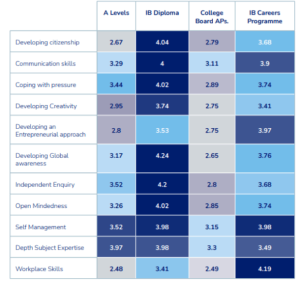
While A Levels and the IB Diploma are rated almost identically for subject expertise (3.97 and 3.98 respectively), the real differences lie in the broader skills universities now say matter most—independent inquiry, global awareness, self‑management, and open‑mindedness.
This reinforces what we know well at Hastings School: The IB Diploma is not just a qualification—it is a complete educational programme. Its structured breadth, emphasis on research, Theory of Knowledge (TOK), the Extended Essay (EE) and through Creativity Activity and Service (CAS) build the habits of mind universities value most.
What This Means for Hastings School’s Dual‑Track Approach
At Hastings, we are proud to be a dual‑track school, offering both the IB Diploma Programme and A Levels. Regardless of pathway, our students must be supported to build the competencies universities are actively seeking.
That’s why we are committed to ensuring all students have access to qualifications and experiences that strengthen their readiness for university, we can further support A Levels by including:
– EPQ (Extended Project Qualification) – developing independent research skills
– IELTS preparation – often essential for international admissions
– PCEs within the Spanish system – broadening pathways
– Participation in clubs, activities, leadership, and service – developing global awareness, confidence, and character.
Looking Ahead
It was inspiring to see such strong alignment between Hastings School’s purpose and what universities now articulate as essential. Whether through the IB Diploma or A Levels/PCEs, we must prepare students to thrive in an ever-evolving world.
Mr.Piper
Principal